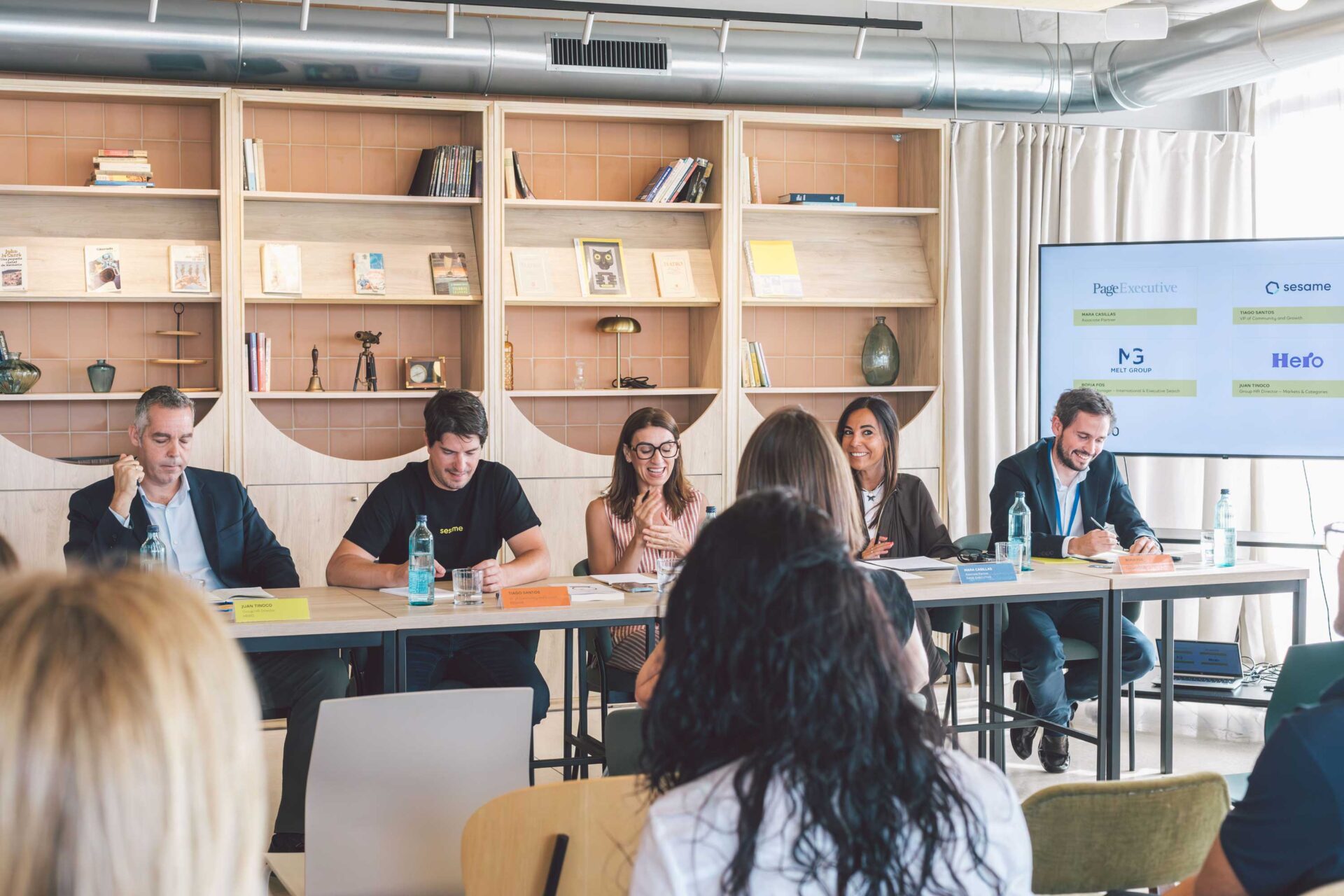
Artificial intelligence is no longer a promise of the future; it is already part of everyday life within organisations. However, one of the main conclusions from the recent event held at Wayco, Beyond AI: How to Develop Human Talent in the Age of Algorithms, was that the real challenge is not technological, but human. Current discussions around artificial intelligence and human resources show that, despite digital transformation, employees remain firmly at the centre of change.
The Collective Adoption of Technology in Organisations
During the discussion, the speakers agreed that technology is transforming the way we work, learn and make decisions. In this context, where AI, human resources and communication increasingly intersect, communication itself is becoming more important than ever: understanding what technology gives us and knowing how to translate that knowledge both within and outside organisations.
According to Tiago Santos, VP of Community and Growth at Sesame, one of the major challenges when integrating AI into human resources is avoiding the emergence of two-speed organisations and teams. Technological adoption, he argued, must be collective. Sharing knowledge, encouraging collaboration and creating spaces for learning are essential to ensure that nobody is left behind. Learning can no longer be an individual responsibility; it must become an organisational capability.
From Technical Expertise to Judgement: The Value of AI in Human Resources
Juan Tinoco, Group HR Director Markets & Categories at Hero, highlighted another particularly revealing idea: for many years, companies primarily hired for technical expertise, whereas the future will place greater value on judgement, interpretation and human decision-making. As new AI tools for human resources continue to emerge, knowledge itself will become increasingly accessible and therefore more of a commodity. What will truly differentiate people is their ability to provide context, make sound decisions and connect with others.
Among the skills expected to shape the coming years, the speakers highlighted creative thinking, leadership, social influence, resilience, learning agility and adaptability. In a corporate environment increasingly shaped by the combination of artificial intelligence, human resources and adaptability, the ability to learn quickly may become just as important as existing knowledge.
The Essential Skill: Unlearning to Evolve
Perhaps the most frequently repeated idea throughout the event was the importance of unlearning. Questioning long-held assumptions, letting go of established truths and being willing to change the way things are done will be essential to evolve at the pace demanded by the market. The challenge is no longer simply to acquire new knowledge, but to continuously reassess what we previously believed to be true.
Alongside this, other concepts highlighted by Mara Casillas, Associate Partner at Page Executive, and Borja Fos, Senior Manager International & Executive Search at Melt Group, included self-awareness, empathy, human presence and identity flexibility. These qualities enable people to adapt without losing their sense of self and become even more valuable in an increasingly automated world.
Less Obsession with Tools, More Focus on Culture
The question is no longer whether technology will transform organisations, but how we will prepare people to live and work alongside it. The answer appears to lie in building cultures of continuous learning, creating ecosystems that facilitate adaptation and encouraging an open mindset towards change. These were among the key conclusions shared by the five industry professionals participating in the discussion.
Key Takeaways on Talent Management
- We used to hire for knowledge; we will increasingly hire for judgement. Knowledge will become a commodity, while human qualities will make the difference.
- The most important skill of the future will be the ability to unlearn. Challenging established assumptions is essential to keep pace with market change.
- We cannot allow two-speed organisations to emerge. Digital transformation within teams must be collective and inclusive.
- Less focus on tools and more attention to culture. The real challenge is preparing organisations to coexist with technology while prioritising leadership and human talent development.
If there is one thing we took away from this conversation, it is the conviction that the future belongs not to those who know the most, but to those who learn, unlearn and learn again most effectively. In truth, this is nothing new. These capabilities have always been part of us; we simply need to be reminded of them and return to the fundamentals of what makes us human.
Because, ultimately, the conversation at Wayco left us with a powerful message: The future will not be technological. It will be human.